
This is a guest post by “Zagloba”.
This is not a story about rape.
In 9th grade, the edition of A Tale of Two Cities we were assigned had an introduction beginning with “This is a book about rape”. Such a pronouncement, of course, immediately leads the savvy reader to ask what happened to all the other things such a book is “about”: revolutions and tyrannies of the masses and guillotines and goodness knows what else.[1] In ninth grade I was not a savvy reader, so I appreciated the reductionism. Of course, that kind of bluntness at the head of an introduction will inevitably color how the reader experiences the story, which is why I’m beginning this post in this way.
The strongest emotional appeals I have seen coming out of the new TSA screening policies have been sexual assault-related. It certainly makes for great outrage material to hear about rape survivors being groped by TSA personnel, and it’s a slam-dunk argument, both in face-to-face arguments and over the internet, that genital groping is completely ineffective as a security protocol. Indeed, the TSA may be realizing that the genital-area searches were a bridge too far for the general public.
The problem as I see it, however, is that the genital-area “enhanced patdown” is two bridges too far. And it is my very current fear that if the TSA agrees to stop touching passengers’ genitalia, we the Public will settle for that, leaving one of our most important and scenic bridges in “enemy” hands.[2]
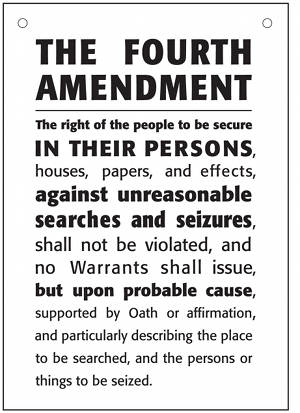
That bridge is the right to be free of unreasonable searches of our persons. This right is not as sexy as the right to remain sexually unmolested by the officers of the U.S. government; this is precisely why it is harder to assemble a coalition of active voices to pressure government to respect the right to be free of unreasonable search.
So, as I say, what follows is not a story about sexual assault, because thankfully none occured. It is, however, a story about an illegal search, a search which was performed under color of coercion, a search which violates an enumerated right guaranteed to me in the Constitution. What follows here is true, and I’ll swear to it in court if given the opportunity. Only the names of the agents involved have been redacted, and that is only because this complaint is not about them, their professionalism or their job performance. Their procedures were “by the book”; their courtesy to me unimpeachable. The complaint is that their job requires them to violate the law, and in a fundamental and low-level fashion.
Without further ado, then:
On 21 December 2010, at approximately 7:20 AM, I approached metal detector/checkpoint 2 at Nashville International Airport (BNA) en route to boarding a Southwest Airlines flight. When I reached the head of the queue, the TSO directing traffic requested that I pass through the backscatter imager. I responded that I was exercising my right to opt out of the scan. In that case, she said I would be subject to the enhanced pat-down and search. I asked her if she had probable cause for a search; she did not answer the question, instead reiterating that I was required to undergo either the scan or the search in order to proceed to the gate. She offered to call her supervisor to speak to me, which I agreed to.
Supervisor X met me outside the metal detector and repeated the statement that I would not be permitted to proceed to the gate without an enhanced screening. I want to emphasize the coercion inherent in this statement: the threat of harm (material loss) as penalty for non-compliance. I asked X if he knew that the search he was asking me to consent to would require a warrant or probable cause if performed by a law enforcement officer; he responded that it would not, due to the regulatory power of the federal government. Of course, the government can’t make illegal searches legal by writing a regulation, and I told him this and mentioned the legal challenges which are in progress across the nation. X had heard of these challenges, and when I brought them up he changed tack: did I have a preference between the two forms of screening? I did indeed have a preference: the pat-down had the overwhelming advantage that it can’t cause cancer.
Allow me to pause for an aside. Any internet lawyer will tell you that once the police have moved from asking if you mind them taking a look, to instructing you to get out of the car so they can search it, you comply and sort out the legality of the order later. I think that X was giving me an out, a way to get me to the gate and through his pipeline. The next time I am pulled out for enhanced screening, once the agent threatens to send me home if I don’t behave, my response will be, “I will not consent to any search unless you have probable cause. However, if you instruct me to undergo the pat-down, I will comply, under protest of course.”
There is a sort of diminishing returns to repeatedly pointing out to agents of the government when they are breaking the law in the course of their job duties. The reality of the situation is that they will win this round — we have to be playing the long game, not expecting that our individual protest will swing the situation to our side. When X instructed me then to please step this way and be searched, I didn’t bother reminding him again that it was an illegal order — he knew, or should have known, that already.
On the other side of the metal detector I was met by TSO Y and manager Z. Y was to perform the search, and Z stated that she would monitor the whole procedure to ensure that everything was done properly. I requested a notebook from my carryon luggage during the search; that request was denied, on the grounds that I had to be kept separate from anything that had already been security-screened until I had been cleared.[3] Z did promise to assist me in recording any details after the search was complete, and did so.
Wearing a fresh pair of blue gloves, Y searched my upper body first, including shoulders, collar, and the sides of my torso. He informed me verbally before moving to each new area, neither asking for nor receiving permission. When Y gave instructions, such as to raise or lower my arms, I complied. After finishing with my upper body, he moved to the lower body, searching the waistband of my pants with his fingers and the inner and outer seams with the back of his hands. He did not search my genital area.
And then I was pronounced free to go. Like hundreds of thousands of others this week, my ability to see my loved ones and go about my business was conditioned on my giving up a fundamental right, or, in my case, having it taken from me without my consent. The difference at the level of the individual is, as I’ve explained above, academic: the government will win the individual battles. It is up to us, however, to bring the war to a battlefield where we have the advantage — first the court of public opinion, then the court of public law.
================
[1] Note to self: re-read A Tale of Two Cities.
[2] No, I’m not a “government is the enemy” type. In fact, I see a broad role for a vigorous and active government which uses the power of public policy to shape the sphere of commonly inhabited space, both real and virtual. However, every government must choose, actively or by default, to be either the guarantor or the enemy of the rights of its citizens; and the recent trend in the U.S. has been precisely opposite to public guarantee of privacy rights.
[3] But legal, if ineffective and counterproductive, regulations are the topic for another day.
Want to see your guest post here? Write 300-800 words on this topic, include links and a large image or video. Send it to [email protected] with the subject “guest blog post”. We look forward to publishing your article!


36 Responses to Guest Post: I’ll Take The Fourth
Leave a Reply
Let’s Connect


[...] This post was mentioned on Twitter by Adam Kissel. Adam Kissel said: RT @WeWontFly: Now: Guest Post: I'll Take The Fourth https://bit.ly/gaWdI8 #wontfly #tsa #fb [...]
Excellent discourse.
Zagloba,
You are worried about cancer from the scanner. Are even you aware (I suspect 99% of Americans are completely unaware) that a remote viewer of one gender watches the naked strip searches of both sexes who pass through the scanner — and of children under 18? If most people knew this I suspect the TSA madness would become much more of a burr under the saddle for most people.
TSA males are trained to frisk females in exactly the same way that female agents are trained. If a woman is at a small airport where only a few agents are on duty and they are all male she is out of luck as far as female on female pat down is concerned — policy. It is all about rape.
Guess what? I have learned to my dismay that local policemen are universally trained in exactly the same techniques for frisking females (will even strip search same in small departments with no women cops). If no female officer is handy they feel perfectly free to enhance frisk handcuffed females (hardly the most dangerous situation they meet). The courts have turned a completely blind Fourth Amendment eye to this. The whole nation is one big airport for women — and for men with openly gay male police (nothing discriminatory against gays here — it’s just that if it is a crime to grope if you are not law enforcement it is the same crime if you are excepting immediate danger which should not be defined as a handcuffed person in a paddy wagon as police seem to universally think).
What the TSA has done is extend this kind of arguably criminal male on female frisking from probable cause and supposed safety of officer situations to assembly line administrative search — as well as ignore laws against voyeurism of the opposite sex and naked child imaging to administrative. Guess what; if the TSA can do thtat whatever justification the courts find should fit just as well at any school or skating rink: there being no discernible legal difference.
Almost forgot 2 out of 7 billion people in the world tried to blow up a foreign originating flight to the United States. Almost forgot: TSA security theater is easily circumvented. Almost forgot: 1,000 extra traffic fatalities in the the 3 months following 9/11 because people switched from flying to driving.
Zagloba, please answer — it might help antis realize the biggest move they can make is to make everyone aware of male on female naked stripping (even police departments make their best effort to avoid that) is the way airport scanners work — were you aware of one remote viewer scanning both sexes? Anybody else want to weigh in on that, please — poll you friends please.
I must confess, I’m not particularly worried about the sexes of the officers doing the search vis-a-vis that of the searchee. It’s a distraction from a Fourth Amendment perspective (thought not from the sexual assault perspective, which is one of the distinctions I’m drawing here).
This is not to say that some individuals, including especially women who have gone through sexual assault, would not be much better served if they are searched by someone of their own sex. I just think that point is a distraction to the illegality of the search in the first place.
I would like to know what a TSA agent would do if a person wearing something like DEPENDS were to go through a pat down? I mean you could really hide some bad stuff in there with all the padding. Would they make you take them off? If not then underwear bombers would NOT be stopped!
They would probably loudly yell “FOREIGN OBJECT” while yanking it out of the underwear.
“every government must choose, actively or by default, to be either the guarantor or the enemy of the rights of its citizens”
No government is the grantor of rights. That is our biggest problem. Both the government and the governed believe rights come from the government. No government gave me my rights. By its very nature the State is always the enemy of the rights of the citizens.
It is the essence of government to grow and become more powerful. The only way to do that is to infringe on the rights of the governed. Notice I did not say “take away” our rights. They cannot take rights away anymore than they can grant them, government can only ignore and violate rights.
I do, however, agree with the fact that this is a fourth amendment issue. (The fourth Amendment was not a right granted by government. I was a demand that government recognize it as they overthrew the Articles of Confederation.) I hope all the law suits around the country are taking that approach.
Where might the First Amendment also come into play here? Freedom of Religion is absolutely being violated here in the case of tenets that demand modesty
@Mit Ailbu
Did you simply misread what the author wrote, or are you actively ignoring it?
He said the government must be the ‘gaurantor’ of rights, not the ‘grantor’ of rights.
According to dict.org, a ‘gaurantor’ is: One who engages to secure another in any right or possession.
According to dict.org, a ‘grantor’ is: The person by whom a grant or conveyance is made.
Clearly, the government is not the ‘grantor’ of rights, as these rights are held by the Constitution to be ‘inalienable’. However, a functioning government could well be the ‘guarantor’ of rights, by passing laws that would protect and curate our existing rights, and by not passing laws in the first place that would infringe on our existing rights
Remember, always read English twice. With over a million words, lots of them look very much alike. I had to read everything twice to be sure, and then check the dictionary.
A bumpersticker I recently saw read:
“Can’t read? Run for Congress!”
It appears to be true. Alas, Congress is not concerned with dictionary definitions of legal matters, the Constitution or anything else right or moral. Instead, they are interested (with only a few exceptions among them) in:
A) Huge money, conflict of interest (Read: Chertoff is the manufacturer of the porno scanners, according to Sen. Bernie Sanders)
B) Power
C) The exercising of falsely-claimed “executive privilege” to back the power and money-based agenda.
Doubt it? If you think that the Congress and Executive are even slightly interested in American freedom, just go to the ACLU’s website. Read posted FBI documents (See who is targeted, overwhelmingly it is peaceful activists and free speech matters being squelched in the name of national security). Read about post-911 legislation. See the Congressional voting record.
Then consult the dictionary, remind Congress to read it, and try to convince them to follow their own understanding of English when trillions of dollars (in their private pockets) are at stake.
I only wish it was as simple as you say. I agree with you, FYI. So do we all, I am sure.
Hello Zagloba and others,
If you must fly, despite the egregious violations of the 4th amendment taking place at the airports under the directives of the TSA, I would suggest you and anyone else, who opts out of the radiation strip search scan, do the following:
Before your sexual groping as a condition of flying, make sure to give the TSA pervert, I mean agent, the Fascist salute and say:
Heil Hitler!
And after they are finished fondling your genitalia, do it again. In case you are wondering, this article describes the fascist salute:
https://en.wikipedia.org/wiki/Nazi_salute
Since, the DHS and TSA are electing to violate the constitution, and are violating the privacy of Americans in the most disgusting, depraved, vile and insulting manner, it is only appropriate to call them what they are and degrade them at an even deeper level.
Others who deserve to be greeted with the fascist salute at this current time, as a result of these new TSA policy are:
Michael Chertoff
The CEOs, officers and employees of L3 Communications and Rapiscan, aka Rapescam
Janet Napolitano, aka Janet Napoleon
John Pistole, aka John #$%hole
and the mighty Fuhrer,
the Commander in Chief himself, sworn in at his inauguration to protect and defend the Constitution:
The Honorable Barack Osama
Gee, I wonder if the Fuhrer would allow some anonymous government agent to view the nude images of his family, as a condition of boarding Air Force One. Knowing what a courageous and principled man he is, I’m also absolutely convinced that he’d never consent to allowing a government agent to fondle the breasts, crotches and butts of Michelle, Malia and Sasha as a condition of flying. But it is okay and just merely frustrating for it to happen to the rest of the disenfranchised electorate, exempting the House and Senate, of course.
Do the above government officials, business people, and government entities have any human decency?
Heil Fuhrer! Is all I can say. And I sing my praises to the Great American Nazi Surveillance State!!!
Gary Alan
At the Tulsa Airport: I was patted down AND scanned. I wear a mastectomy prosthesis, which was not detected. What if it had been? I am a woman in her 60′s who was traveling alone . . . what would have happened to me had they found it?
BUT – since they did NOT find it . . . what’s the point of all the scanning and groping? And I also wonder if any sleeping cancer cells, that still may be lurking in my body, were re-awakened by the effects of the scanner?
I WILL NOT FLY AGAIN.
Yes, I know “groups” don’t have rights, individuals do. But picture the following as we rapidly devolve into the abyss of blue gloves, group rights and bureaucracies that never die …
Imagine a gay man being scanned, but something triggers an enhanced patdown. He is taken to the patdown area and is instructed about the procedure. The gay man asks for a lesbian woman to do his patdown. He remarks that a straight man, a gay man or a straight woman doing his patdown is as offensive to him as straight man doing a patdown on a straight woman.
Of course, the TSA agents, already violating the Fourth Amendment for a pay and benefits, would simply say, “Scans, hands or the can. Nobody flies for free.” That’s because the next act in the security theater hasn’t opened yet to include consideration of gay, lesbian and transgendered persons.
When might that next act start? Look to Congress. With enough complaints against the TSA Congress will meet with the TSA and adopt something, no matter how ridiculous, insane or costly, as long as it: (1) shows Congress doing “something” and (2) preserves the TSA bureaucracy.
With the rejection of “Don’t ask, don’t tell” in the military, look for the TSA to adopt a “Just ask, just grope” policy. They’ll be looking to hire gays, lesbians and transgendered of all stripes just to staff all the human combinations and permutations needed to fill the blue gloves. Hiring by sexual orientation — mandated by Congress!
You can often tell when government policy violates individual rights (guilty until proven innocent) by looking at policy maintenance. To maintain the first violation of rights requires the violation of other rights. In this scenario, there will be quotas on TSA hiring for gays, lesbians and the transgendered.
Of course, this is just speculation. It’s not like there have ever been government policies that institutionalize favoring one class of person over another. Have there?
Mark:
I believe I am not alone among visitors to WWF in asking, er, WHAT ARE YA TALKING ABOUT!!?? How do you extrapolate from the repeal of DADT in the Military that government is soon to MANDATE the hiring of people as TSA agents BECAUSE of their orientation?
My opinion is that we here at WWF should be concerned with things that the TSA are actually doing at the airport, not what our own phobic imagination can conjure up. Let’s not confuse the issue here. DADT is a military issue which has absolutely nothing to do with the TSA.
What these TSA thugs need to remember is Nuremberg. They will each be held to account for their actions one day and then there will be a reckoning – just as there was at the end of the Nuremberg Trials.
Yes, all of you feds trampling on our rights take a good hard look at history. Look what general populations have done to their oppressors when they were finally fed up. That is you future.
While I disagree entirely with the TSA’s policy and procedure, an even more ridiculous thing to me is that these procedures (enhanced pat-down, backscanner) are not applied at every airport. I have flown several times in the last few months. In no case, at 4 different airports, did I have either the backscatter machine OR a pat down. All I went through was the usual metal detector. What’s the point of these procedures at all if they’re not done at every airport? In fact, in my understanding, the Rapiscan machines are only at about 68 or so airports. So if anyone wants to go “old school,” a la the underwear bomber, I recommend they go to any airport that is NOT doing all these illegal and pointless “security” procedures.
Everyone is outraged about the TSA now. Where were all these people when 75% of the states violated their 4th Amendment rights by allowing drunk-driving checkpoints? “Oh, those are ok. It’s to catch drunk drivers,” I bet they said. That’s how it starts. Whittling away at your rights, and the people give them up freely in the name of the children or “safety” or whatever else. And let’s not forget the illegal checkpoint stops Border Patrol has 50 miles from the border.
I’d still like to know how the upcoming mass-transit, local patdowns and searches are going to go when 49 states have some form of concealed or open carry of guns. “Yep, he’s clean! …except for the gun on his hip.” ??
TSA=Totally Stupid A-holes
I hate feds says:
“What these TSA thugs need to remember is Nuremberg. They will each be held to account for their actions one day and then there will be a reckoning – just as there was at the end of the Nuremberg Trials”.
Right on I hate feds, same is going to happen to the REAL perpetrators and masterminds of Sept 11 2001
You will get your just deserts you evil and sinister monsters!
Rob recently posted..US Refuses Cooperation With Poland’s CIA ‘Black Site’ Probe
Jack Webb on child molesting:
https://www.youtube.com/watch?v=K8b14WkV2LE
A great and thoughtful article. I do strongly disagree on one issue though. Protecting the identities of the TSA persons involved and crediting them with professionalism seems to mitigate the fact that they engaged in criminal behavior. Simply stated, “I’m just doing my job” does not excuse someone from accepting the responsibility for their actions. If my employer were to order me to rob a bank, do you think that I should be free from criminal charges because I was only “doing my job?” These TSA employees choose to go to work every day knowing that what they are doing is immoral and unconstitutional. They witness each day the anguish they create in innocent men, women, and children. They are at worst power hungry predators, and at best people without principles who are willing to harm others in exchange for money. Do not give them credit for being anything more honorable than that.
I have quit more than one job because the employers wanted me to engage in illegal or unethical activities. The TSA employees have the same option available to them. They choose, each day, to betray their country and it’s citizens for a paycheck.
Oh, I have their names, and if (as I say at the beginning) I were somehow asked to testify in a prosecution or lawsuit against the TSA, those names would be named. I don’t feel it’s appropriate to air those names on the internet, however.
The main reason for this is that individuals are much less powerful than systems, and our goal should be the dismantling of the security-theater system, rather than simply blaming global behavior on local factors. These TSA agents go to work every day knowing what they’re doing is illegal and wrong, yes; and if they were to resign in protest the TSA would hire someone else to do the job they vacated. (Hello, asymmetrical job market!) And yes, while I’d like to think that if I were in their position I’d be responding differently, my larger point is that, from a strategic perspective, simply targeting the agents who are the public contact point of bad policy is usually completely ineffective at reversing or preventing bad policy.
What a pathetic cop out. You are protecting people who do wrong. That is tantamount to doing wrong yourself.
I have become a ‘the govt is the enemy’ type from awhile back when I noticed how freedoms were being curtailed in ways large and small- from the freedom to raise your kids free from nanny-laws, to buy a parcel of land and do what you want w/it being illegal, to simple OTC medications taken away to a limit on how much cash you can carry, to suspension of the Constitution w/ freedom of speech on the internet to the TSA nazi-like control of right to travel. A million little cuts w/ a few big ones thrown in for good measure.
First let me say that no one is more opposed to the current situation with Airport security then I am. I believe that security is more important than some misguided notion of political correctness and if our government was serious about protecting us from the threat at hand, they would be profiling people who are from that part of the world where a sizable percentage of the people wish to do us harm. Isreal uses this approach and has had great success in preventing terrorist attacks on its aircraft. That is where the threat is coming from, not from some blond teenage girl or some white haired Irish Grandmother or Japanese tourist.
However, as an attorney, I would like to address the Constitutional issues raised under the 4th Amendment. As a guy who considers myself a Constitutional scholar I could write pages about how I bleive that the Government is violating the constitution. However, no one in America has a RIGHT to get on any airplane except one that they own. It is sort of like if you were to visit a military base. You have no right to go onto a military base. When you approach you will see a sign that says proceeding forward constitutes consent to search. All that you have to do is continue forward and you have consented. You are free to turn around and drive the other way. Remember that probable cause does not even become an issue because it is an either/or scenario. The government does not need both probable cause and consent. If they truly have probable cause, they can search you without consent. Conversely, with your consent, there is no need for probable cause. When you approach the secured area of an airport you now see the same sign that you have seen for years outside of military bases. You are free to turn around and find another form of transporatation if you so choose.
There have been people who drove up to the gate of a military installation, had their car searched and were caught with drugs and other prohibited things. These cases have been challenged again and again in the courts and every time the courts have found that consent was given by the action of approaching the gate. I believe the TSA has the same consent.
I do not like what they are doing right now. But, I do not believe it violates our Constitutional rights.
Yet there *is* the right to contract and furthermore it is fundamental to a vibrant economy. TSA is getting in between a contract made between traveler and airline. This is a violation of the right to contract. And you don’t have to find that in the constitution. It predates it.
There can be no consent to aggressive violence. The TSA has forced itself on people. There is no choice involved. Where there is no choice, there can be no possibility of consent.
To say that people can choose to travel in a different way is spurious. That’s the way I chose. I made a contract with the airline. Now the TSA wants to force its way into that agreement, and break it if need be. This is morally wrong and economically dangerous.
Danny Philips, let me respond as one who lived next door to the former Iron Curtain and saw how serious the situation was there, and all the extraordinary parallels here in post-911 USA…that you are arguing the letter of the law without thinking of the spirit of it, let alone arguing it.
You are wrong. It is our fundamental right to travel freely. Think about it.
So people with family overseas have no right to free travel?
People with jobs requiring flight have no right to free travel?
People desiring or needing a vacation get-away have no right to free travel?
By that definition, we will all be squelched and sitting in our homes while begging the government for permission to do as we please.
This is no exaggeration, I promise you. Dictatorships take family members hostage when a person travels without government permission. That is what they did behind the former Iron Curtain, as told to us by friends who left the country. With government permission, of course. The only reason why they had that permission in the first place was for economic reasons, they were studying a subject not available within the country’s borders. In fact they had to use that as the pretext for their permitted travel.
Our unsuspecting innocence is our American downfall. Watch out for that!
Obama already has claimed the right to shoot Americans dubbed at his unilateral pleasure as enemy combattants, in absence of judicial review. Tianenmen Square coming to America within the next decade? I predict it will be a lot sooner than that. The time to peacefully and legally oppose this fascist dictatorship is NOW, not to support it, in writing as you have unwittingly done.
Danny Phillips,
You don’t have a right to take a walk through the judge’s chambers — you do have a right to travel freely in the open. Here is my latest screed — still working on — if you are right then naked scanning and opposite sex frisking is on its way to schools in you town.
***************
TSA extends sexually abusive searches from probable cause and police safety to administrative search and public safety
Most police departments train male officers to frisk females if no female officers are handy or pretty much whenever they think they can get away with it. Any hope for Fourth Amendment protection from badge blinded courts has evaporated over the decisions: https://www.rbs2.com/travel2.pdf . Small police departments with only a few officers will also strip search female prisoners, presumably of any age: https://www.youtube.com/watch?v=pWokzdFBNLs .
All courts require for what would otherwise be criminal sexual intrusion is probable cause of commission of crime or any claim of officer safety (afraid to transport a handcuffed 15 year old girl): https://www.lawforkids.org/speakup/view_question.cfm?id=269&topic=OTHER .
The TSA wants courts to approve the same degrading male on female frisking anytime there is no female agent available (small airports may have only a few agents) or whenever they can get away with it – but for assembly line, administrative search for public safety. If this is approved, then, the same jurisprudence should justify assembly line sexual assault at any school or skating rink.
Going by this AP story and pictures small Douglas County, Colorado courthouses may have already forgotten about same-sex frisking and remote viewers not seeing you: https://www.ajc.com/news/nation-world/full-body-scanners-popping-752566.html . Has giant Cook County, Illinois courthouse which reportedly had descended to whole body scanners forgotten too? Some media could check.
[Hint: small police departments: you can use scanners with remote female viewers. Good enough for giant Cook County jailhouse -- good enough for you.]
ACLU Know your rights if encountering law enforcement:
https://www.aclu.org/…/know-your-rights-when-encountering-law-enforcement
ACLU know your rights if queried by the police:
https://www.aclu.org/drug-law…rights…/know-your-rights-what-do-if-you
ACLU know your rights if queried by the FBI, police or DHS agents:
https://www.aclu.org/images/resources/kyr_english.pdf
There is one common denominator. We have the right to “Just Say No”:
“I do not consent to being searched”.
Further, permission to be searched or silent acquiescence as implied consent for search, means that things can later be used in court against us too. Less likely to be held against us in court if we “Just Say No”.
But that doesn’t mean that we won’t be….arrested, singled out, escorted out of the airport, fined $11K for refusing to be searched, and queried by police.
That is where this is not merely a 4th amendment violation, but a first. It is no accident that free speech is the very first amendment in the US Constitution. I want to see lawsuits addressing this en masse. Too many are stressing merely the 4th amendment, which is part of it but not adequate. It’s not the total picture. Too many people are being harassed by the TSA for speaking up. And they have every right to object.
Very well written article, BRAVO and thank you!!!!
PS Can anybody spell “Virtual gunpointing” ?
Why isn’t this being talked about everywhere and being the major point of lawsuits?
Virtual gunpointing, sexual battery, controlling the borders, 1st amendment violations, 4th amendment violations…this whole thing is unconstitutional on its face.
Note the words in the 4th amendment ” *particularly* describing the person or things to be seized”
So these basket no-warrants really “Don’t fly” with the law.
The land of the free OR the home of the brave? YOu choose. Read this:
Report: Homeland Security Compiling TSA Enemies List https://www.thenewamerican.com/…/5354-report-homeland-security-compiling-tsa-enemies-list
(in this article above, it is absolutely abundantly clear that free speech is under active and deliberate attack by the US government and Janet Napolean-o via TSA actions and other matters):
This is a bit more hopeful:
How long will travelers put up with TSA intrusions?
https://www.allbusiness.com/crime-law-enforcement…/15340274-1.html – Cached
Thanks for your dedication and courage in exposing the fraudsters at TSA and their way too intrusive scanners.
Who keeps an eye on the scanners?
Are there perverts among them that take cell phone pics of some good looking man or women or even a child, then sell them to pornographers?
Or take them home to use for personal gratification?
This needs to stop NOW before they use another FALSE FLAG as an excuse to set these machines up in a bus or subway stop or AMTRAK.
Greg Bacon recently posted..World Zionist Org- Dictating Terms at the 1919 Paris Peace Conference
https://www.airsafe.com/issues/security/tsa-sop-not-redacted.pdf
****************************************
****************************************
2.2.3. HHMD OR PAT-DOWN SCREENING OF INDIVIDUALS
The HHMD TSO is responsible for HHMD screening and pat-down inspections in accordance with the Screening Checkpoint SOP. All HHMD and pat-down searches must be conducted by TSOs of the same gender as the individual presents him or herself to be. Extraordinary circumstances may occur where a TSO of the same gender is not available, including staffing shortage emergencies at any airport or limited staffing at category II, III, and IV airports. Under these circumstances, TSOs of the opposite gender may be allowed to screen individuals in accordance with the provisions of Chapter 4.3.14 of this SOP. During opposite gender screening an STSO or LTSO, if possible, should be present. This rule applies to all references of same gender screening in the Screening Checkpoint SOP.
*******************************************
*******************************************
Revision: 3
Date: May 28, 2008
Implementation Date: June 30, 2008 Screening Management SOP
4.3.14. OPPOSITE GENDER SCREENING
Extraordinary circumstances may occur where a TSO of the same gender as the individual being screened (the gender of an individual is determined by who he or she presents themselves to be) is not available to complete HHMD and/or pat-down screening procedures (for example, staffing shortage emergencies at any airport or limited staffing at Category II, III, and IV airports). Under these staffing shortage emergencies, screening procedures for individuals of the opposite gender, as provided for in this Section, are authorized and STSOs must apply the following procedures.
A. The following notifications must be made within 24 hours of each new staffing shortage event:
1) The STSO must notify the FSD, specifying the anticipated duration of the staffing shortage. The STSO must provide subsequent updates to the FSD if the reported duration is exceeded.
2) The STSO must maintain a count of the number of passengers affected during the staffing shortage and report these numbers to the FSD after the shortage is resolved. No personal or identifying information must be taken from the passenger for purposes of this report. For example, “three female passengers underwent opposite gender screening at Airport X” is an adequate count; however, including the names of the three female passengers in the count would be inappropriate. [my note: Do Touch; Don't Tell]
3) The FSD must in turn notify the Area Director, who must monitor such reports and consider how the patterns of staffing shortages, if any, can be addressed. The Area Director or his or her designee must notify the Office of Civil Rights of the staffing shortage and provide a copy of the report indicating the number of passengers subjected to opposite gender screening at each affected airport.
B. The STSO must ensure that the following notice is provided to an individual of the opposite gender before the individual enters the WTMD:
1) A TSO of the same gender as the individual presents him or herself to be is not available.
2) A TSO of the opposite gender will be required to complete the screening process, which may include physical contact between the TSO and the individual.
3) An LTSO or STSO, if possible, will be present.
4) Once the individual enters the WTMD, the individual must complete the screening process.
[I repeat: " 4) Once the individual enters the WTMD, the individual must complete the screening process." Sorry high school girl!]
Please translate the above acronyms/definitions into plain English, please. Thank you, and a very Happy New Year.
I’m sorry; you will have to go to the web link on top to unscramble the acronyms. I just bumped into the page on the web this morning. And a very Happy New Year to you.
Danny Phillips says:
December 29, 2010 at 10:31 pm
“As a guy who considers myself a Constitutional scholar” AND “When you approach the secured area of an airport you now see the same sign that you have seen for years outside of military bases.”
Let me say that you may want to reconsider your current career path if you truly believe that TSA is not violating the 4th amendment.
By your logic, if a Government agency throws up this same sign at the on ramp of an Interstate Highway, they now have free reign to search any vehicle who proceeds onto the Highway. DUI checkpoints are illegal in most states and even where they are allowed they must follow certain restrictions and are not open ended searches.
Other posters are correct when they say that an airline traveler is contracting between a private business and the traveler. When the Government partners with business in such a way that it violates the rights of citizens, that is a text book definition of Fascism.
In many respects, the airline industry is an extension of the hospitality industry. At least, it used to be.
The trouble is not government. The trouble is big, intrusive, un-Constitutional government. I hope that all of you on the We Won’t Fly blog and the founders call atention to the Meetup group I created to schedule more of a cohesive, massive boycott.